
When applications drop after switching ATS, the software is rarely the whole story. Something else usually changed in the same week. Your jobs stopped reaching Indeed or LinkedIn for free, the apply form got longer, the post lost its salary, or old links broke. A 15-minute check finds the main cause before you blame the tool.
By Dev Rishi Khare, former machine learning engineer at Amazon (search and recommendations) and Synopsys
"Since Indeed started to cap free postings to 3, we decided to try an ATS. Since then our applicants have gone down to 0-2 per posting over the last 2 weeks."
An employer posted that in an r/recruiting thread called Big drop in applicants since switching to an ATS. In the same post they added: "My ATS suggests I should sponsor posts."
If your numbers fell the month you moved systems, you're in the same spot.
The diagnostic and rules of thumb below are Dev's view, not measured data. Indeed's and Google's rules are taken from their own pages and linked by name.
Five things a switch can change
In Dev's view, a switch changes several things at once. Check all five, in any order:
- Distribution. Your old tool or your old habit pushed jobs to Indeed and other boards. The new setup doesn't, or does it on different terms.
- A longer apply flow, with account creation, retyping what's already on the resume, or a long list of screening questions. Test it on a phone.
- A rewritten job post. It got poured into a new template and lost its salary, or gained a vaguer title.
- Missing Google for Jobs data. The new careers page may lack the JobPosting structured data Google reads, so your jobs fall out of Google's job search.
- Broken links. Job URLs changed, and every old link on your website or social posts now goes nowhere.
What changed at Indeed in 2026
Indeed has changed its rules for free listings, and a switch can move your jobs from one set of rules to another. Check these details on Indeed's own pages before you act on them, since Indeed can change them.
The free job post limit
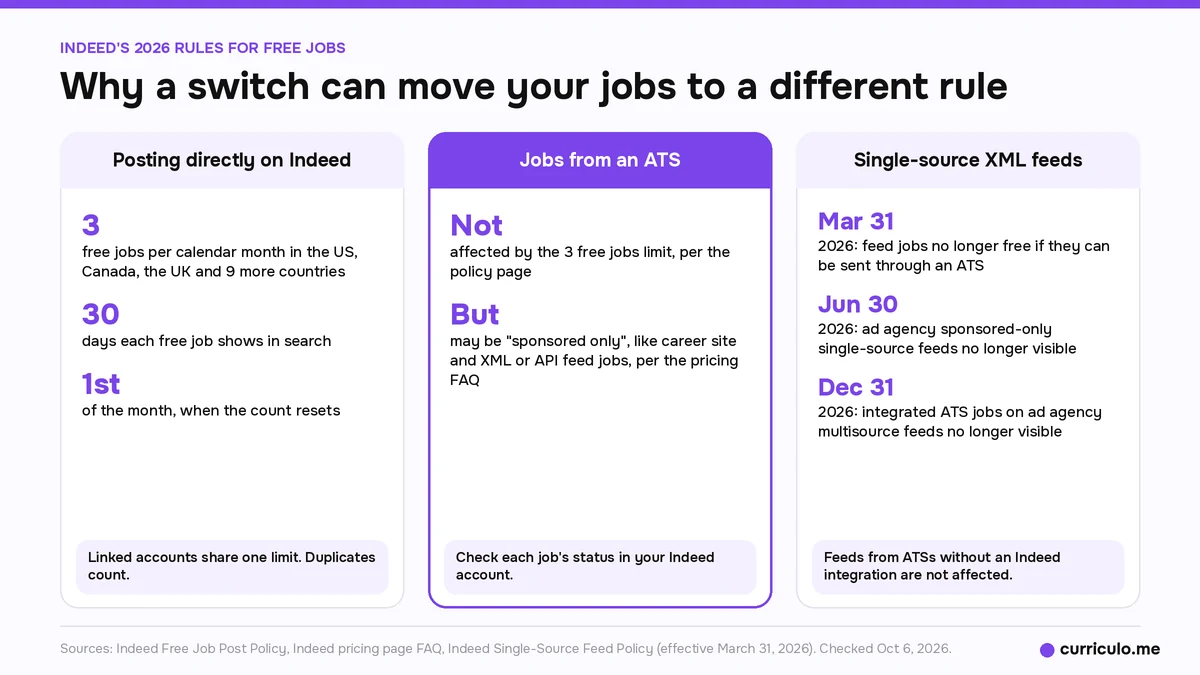
Indeed's Free Job Post Policy allows up to 3 free jobs per calendar month in the US, Canada, the UK and several European countries, each shown for up to 30 days. The count resets on the 1st of the month at 12:00 AM in your time zone. Linked accounts under one parent company share the limit, and duplicates count toward it. After that, you can pay to sponsor. The page also says the limit applies to jobs posted directly on Indeed, and that jobs posted through an ATS are not affected.
Sponsored-only jobs
That doesn't mean ATS jobs show up for free. The FAQ on Indeed's pricing page says some jobs are considered "sponsored only". Its examples include jobs aggregated from a career site or company website, jobs from a data feed such as XML or an API, and jobs published from an ATS. Indeed also reserves the right to require sponsorship for any reason.
The single-source feed policy
Indeed's single-source feed policy, effective March 31, 2026 says jobs sent through single-source XML feeds no longer appear for free if they can be sent through an ATS. If your ATS is integrated with Indeed, you must use that integration. Feeds from ATSs without an Indeed integration are not affected. The same page sets later dates for ad agencies, June 30, 2026 and December 31, 2026.
Read together, these pages offer one likely explanation for the Reddit poster's drop. Leaving direct posting got them out from under the 3-job cap, but jobs arriving from an ATS can still be sponsored-only. Log in to your Indeed employer account, check whether each job is live and whether it's marked as needing sponsorship, and ask your ATS vendor exactly how your jobs reach Indeed.
The 15-minute diagnostic
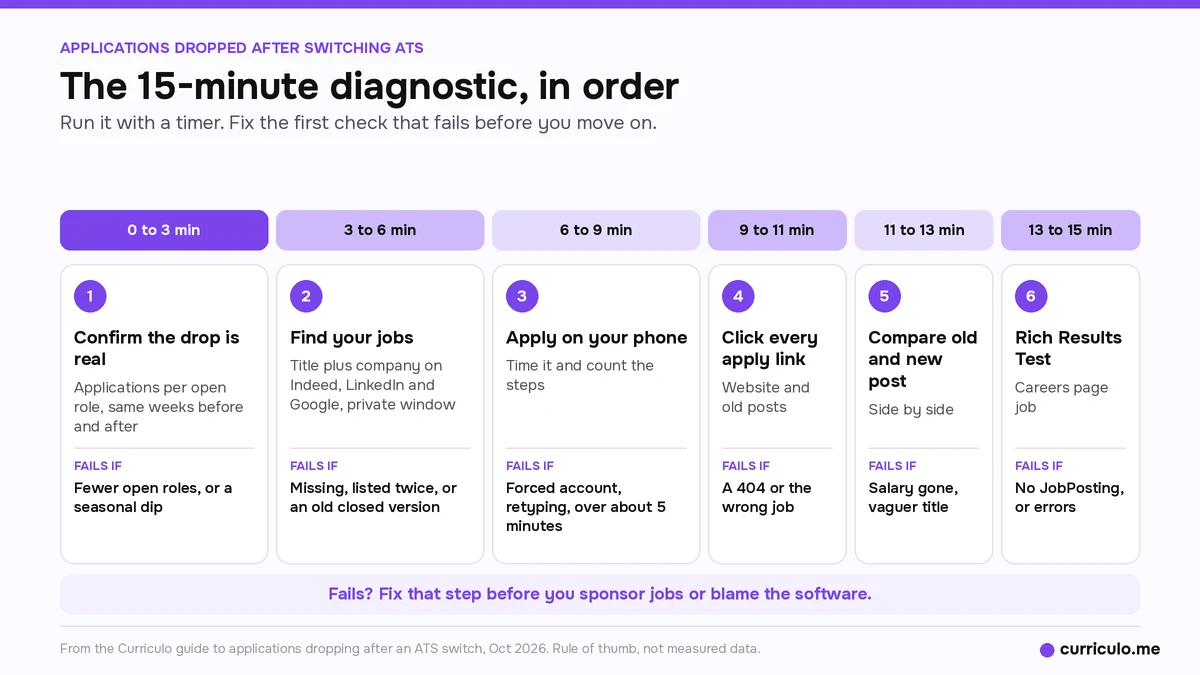
Run these steps in order with a timer. Dev's rule of thumb is to fix the first step that fails before you move on.
| Minutes | Check | What a failure looks like |
|---|---|---|
| 0 to 3 | Confirm the drop is real. Compare applications per open role for the same number of weeks before and after the switch. | You have fewer open roles, or the dip matches a seasonal slowdown. That's not an ATS problem. |
| 3 to 6 | Search for your job title plus company name on Indeed, LinkedIn and Google's job search, in a private browser window. | The job is missing, listed twice, or an old closed version shows instead. |
| 6 to 9 | Apply on your phone. Time it and count the steps. | A forced account, retyping the resume, many screening questions, a broken upload, or more than about 5 minutes. |
| 9 to 11 | Click the apply link from every place it appears, including your website and old LinkedIn posts. | A 404, a redirect to the home page, or the wrong job. |
| 11 to 13 | Put the new post next to the old one. | Salary removed, a vaguer or internal title such as Associate II, or must-haves buried. |
| 13 to 15 | Run your careers page job through Google's Rich Results Test. | No JobPosting found, or errors on required fields. |
If step 1 shows the drop is real, the numbers to watch while you fix it are in the guide to ATS metrics for small hiring teams, starting with applicants per source and time in stage.
When to pay to sponsor, and when to stay organic
Dev's view is to fix the post and the apply flow before you pay anything. Sponsoring a broken funnel buys more people who drop off.
Sponsoring makes sense when the role is urgent, high volume or hourly, or in a competitive market where organic posts sink within days. It also makes sense when a good post has drawn too few qualified applicants after 7 to 10 days.
Organic posts plus a shared link work better for niche or senior roles that you'll source or fill by referral. They also suit teams whose network reliably reaches the right people, and agencies that headhunt. If that's your desk, the guide to choosing an ATS for independent recruiters covers the tool side.
What a good mobile apply flow looks like
Dev's target is about 2 to 3 minutes on a phone. Ask for name, email, phone and a resume that accepts PDF and Word, and ideally a LinkedIn URL as an alternative. Ask for location or work authorization only if the job needs it. No account creation, no retyping, and no more than 3 job-critical screening questions plus one optional free-text box.
Use knockout questions only for binary legal or job requirements, such as work authorization, a license, a hard location or a shift. Phrase them neutrally, and never use them to filter on years of experience or skills. Write down what each one filters out and check it now and then.
LinkedIn Easy Apply and similar one-click options bring more volume for less effort, but more low-fit applicants and more screening work too. That also means more people to turn down, and the guide on how to reject applicants without ghosting anyone covers doing it in batches. Your own page brings fewer, more intentional applicants, plus your own data. Dev's rule: niche, senior and agency roles go to your own short page; high-volume or hard-to-fill roles go to Easy Apply plus ranking. The resume screening guide to keyword scans, manual review and AI scoring shows how to rank a big pile. If people drop off after a redirect, check the form length at the destination before you blame the redirect itself.
If you fix one thing, apply on your phone and delete every field or question you wouldn't use to decide. Start with account creation.
Getting Google for Jobs right
Google's job search is free, though in Dev's view it rarely replaces job boards for small employers. Treat it as a way to make your careers page findable, not as a channel to rely on.
Google's job posting structured data guide on Search Central lists the required JobPosting properties as title, description, datePosted, hiringOrganization and jobLocation. For a fully remote job, it says to use jobLocationType, and jobLocation isn't required if applicantLocationRequirements is present. Recommended properties include baseSalary, employmentType, directApply and identifier. The guide says validThrough is required for postings that have an expiration date.
Dev's order of priority among the fields you fill in:
- Salary, the biggest lever.
- A precise location or remote setup, such as "remote, US only" or "hybrid, Brooklyn, 2 days."
- An accurate date posted. Close or remove jobs when they're filled, because expired jobs left live hurt trust.
- Employment type, which matters least.
Is it the ATS, or something else?
According to Dev, the ATS is the likely cause if the drop started the week of the switch, was sharp rather than gradual, and sits in one channel or one step. Signs of that are jobs missing from boards or Google, or applicants who start but don't finish. Other employers in your market should also be unaffected.
Something else is likely if the decline was gradual or began before the switch, or shows up in every channel including referrals and direct applicants. Other suspects are seasonality around holidays or quarter end, or a shift toward more senior or niche roles. So is a change in pay or remote policy, a market where competitors are hiring hard, or news about your company.
No recovery after 2 to 3 weeks
If you've fixed what the diagnostic found and nothing has improved in 2 to 3 weeks, Dev's next steps are:
- Split the funnel by source. Did views fall (a reach problem), or did views hold while applications fell (a conversion problem)?
- Compare with the same weeks last year, for roles that didn't change.
- Put your pay and title next to 3 to 5 comparable live postings.
- Ask your last few applicants, and a few people who didn't apply, how they found the job and what nearly stopped them.
- Check whether sponsored budgets or sponsored status lapsed with the old tool.
Switching back is rarely the answer, in Dev's view. Do it only if the new tool lacks something your business depends on, such as a required board feed, and the vendor can't fix it in a reasonable window. An undiagnosed dip will follow you to the next tool.
The myth: the new ATS killed our applicants
It's the easy story, and it's usually incomplete. A switch changes distribution, the apply form, the post and the links all in the same week. Run the diagnostic before you blame the software.
If you report to clients, Dev suggests a short note. Give the drop in real numbers, like for like, and what you checked and ruled out. Then give the likely cause with a fix date, and what it means for their shortlist. Promise the process and a date when you'll know more, not an applicant count.
Where Curriculo ATS fits
Curriculo ATS gives you a public careers page for your jobs. Every job page includes JobPosting structured data, the format Google for Jobs reads, so your jobs are eligible for Google's job search once the page is indexed. Share your job link or careers page anywhere, including LinkedIn. Starter is free forever, and Pro is $50/mo early-bird (50% off the $100 list price), with no per-seat fees on any plan. More on the careers page is in the free careers page builder.
Frequently asked questions
Why did our applications drop after switching ATS?
Usually because several things changed at once. Jobs stopped reaching Indeed or other boards for free, the apply form got longer, the post lost its salary or title, or old links broke. Run the 15-minute diagnostic and fix the first step that fails.
Does Indeed still allow free job posts?
Indeed's Free Job Post Policy allows up to 3 free jobs per calendar month in the US and several other countries, each shown for up to 30 days. Indeed's pricing page says jobs from an ATS, a feed or a career site may be sponsored only.
Are ATS jobs affected by Indeed's 3 free jobs limit?
Indeed's policy page says jobs posted through an ATS are not affected by the limit. Its pricing page also says ATS jobs may require sponsoring, so check each job's status in your Indeed account.
What fields does Google for Jobs require?
Google's Search Central guide lists title, description, datePosted, hiringOrganization and jobLocation as required. Fully remote jobs use jobLocationType instead of a physical location. Salary and employment type are recommended, and validThrough is required when the posting expires.
Should we switch back to our old ATS?
Rarely, in Dev's view. Switch back only if the new tool lacks something your business depends on and the vendor can't fix it in a reasonable window. An undiagnosed dip usually follows you to the next tool.
More guides on hiring tools and job posts are on the Curriculo ATS blog.