
The average number of candidates interviewed per hire is roughly 3 to 4. CareerPlug's 2025 report (2024 data) puts interview to hire at 27%, which works out to about 3.7 interviews per hire, and SmartRecruiters reports 3 people interviewed and 1 offer per role. Gem's figure of 20 counts every interview session, not 20 people.
By Dev Rishi Khare, former machine learning engineer at Amazon (search and recommendations) and Synopsys
You've probably seen two very different answers to this question. One says you interview three or four people per hire. The other says twenty. Both come from real reports, and both are correct, because they count different things. If you plan your week or quote a client a timeline off the wrong one, you'll be off by a factor of five.
Every benchmark below links to its report and names its year. Anything labelled as Dev's view is his rule of thumb for small teams and independent recruiters, with no dataset behind it.
What the published benchmarks say
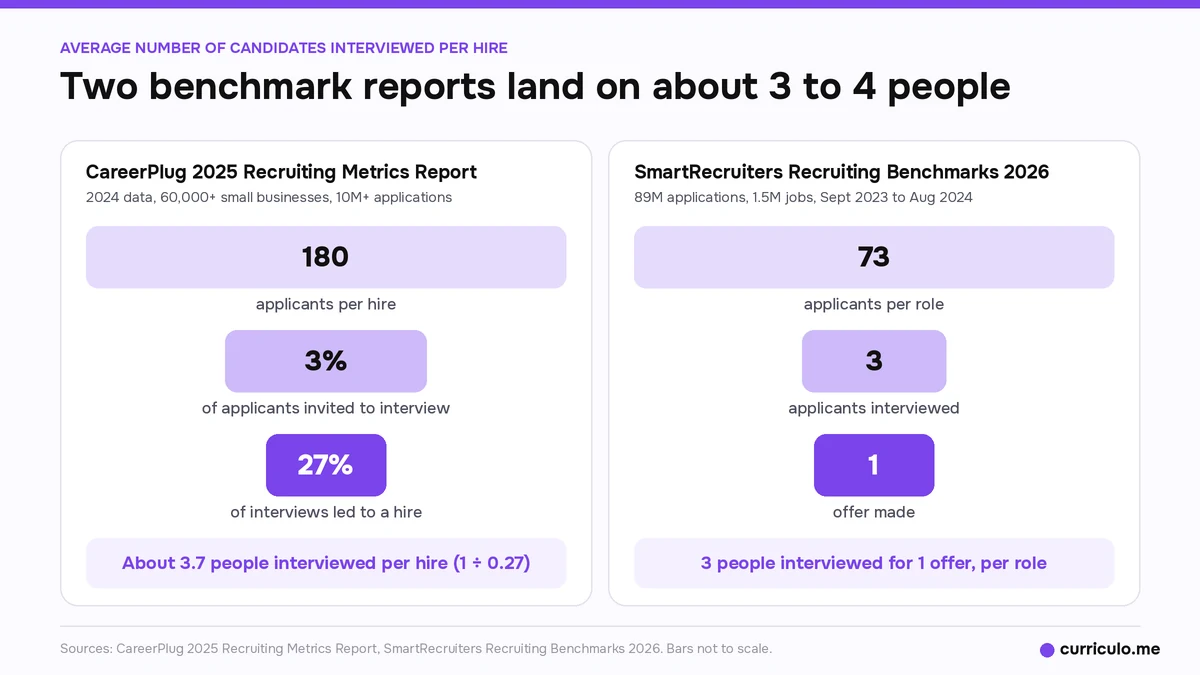
CareerPlug's 2025 Recruiting Metrics Report looks at 2024 hiring activity from more than 60,000 small businesses and over 10 million applications. Its headline funnel numbers:
- 3% of applicants were invited to interview.
- 27% of interviews led to a hire.
- Employers received about 180 applicants for every hire.
- That figure varied widely by industry, for example about 234 applicants per hire in automotive and 57 in education and childcare.
If 27% of interviewed candidates get hired, you interview about 3.7 people per hire (1 divided by 0.27). Round it to about 4.
The SmartRecruiters Recruiting Benchmarks 2026 report covers 89 million applications for 1.5 million jobs in 95 countries, from September 2023 to August 2024. On average it found 73 applicants per role, 3 applicants interviewed and 1 offer made.
Two very different datasets, one from small businesses and one global, land close together: three or four people interviewed per role or per hire.
Why Gem says 20 interviews per hire
Gem's 2025 Recruiting Benchmarks takeaways report that hiring teams conducted 20 interviews per hire, up from 14 in 2021, and that average time to hire grew from 33 to 41 days.
That 20 is a different measure. Gem's 2026 Recruiting Benchmarks Report (a free download) defines interviews per hire as the total number of interviews conducted by recruiters and interviewers to fill a role, including interviews with the person hired and everyone else considered. Gem describes it as a measure of recruiter and hiring team workload.
For example, four candidates who each go through a recruiter screen, a hiring manager call, a panel and a final round add up to 16 interviews in Gem's count.
In the 2026 report, Gem puts the overall figure at about 20 interviews per hire, up 33% since 2021, a rise also covered in Gem's 2026 report takeaways. Technical roles run much higher. Engineering averages 35 to 36 interviews per hire, and design and product management 37 to 39. Non-technical roles vary widely: Gem reports customer service hires at under 10 interviews on average, while sales climbed from 14.0 in 2021 to 21.3 in 2025. Small companies with 1 to 99 employees saw the sharpest rise, with interviews per hire up more than 70% since 2021.
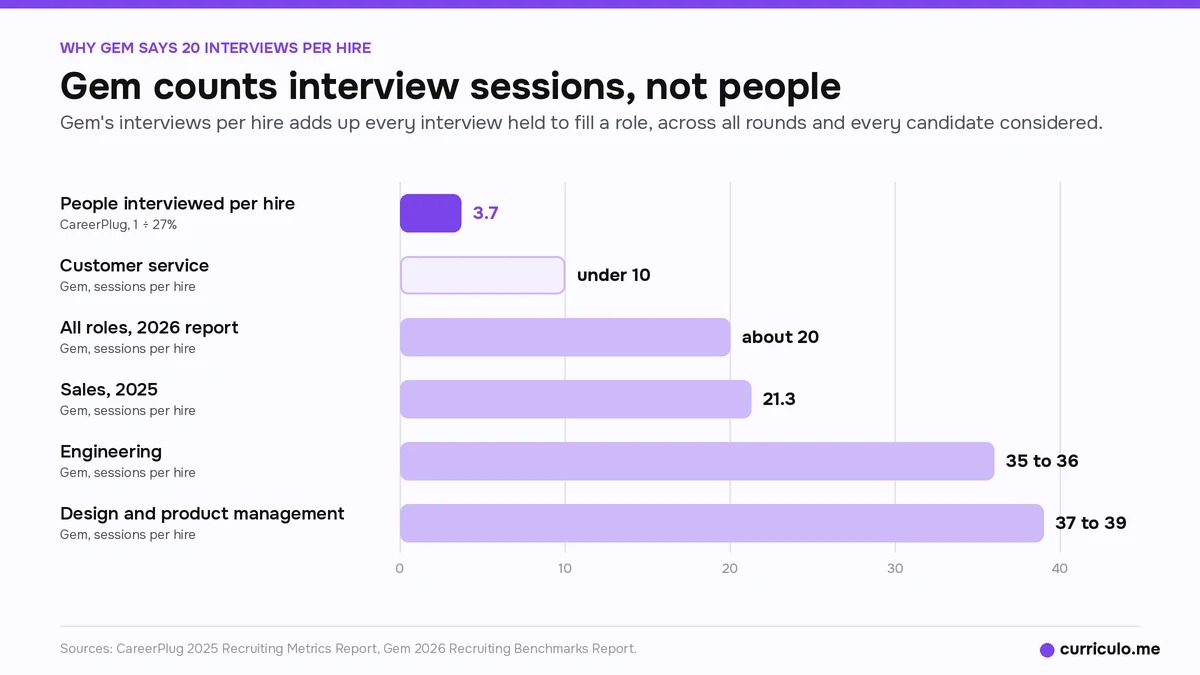
In Dev's read, Gem's figures reflect teams that run multi-round loops. A solo recruiter or a five-person company rarely runs a six-round process. Use Gem's 20 to plan interviewer hours. Use the 3 to 4 range to plan how many candidates you need at first interview. For more on loop length and cycle time, see the time to hire and interviews per hire benchmarks for 2026.
Healthy conversion rates at each stage
| Stage | Benchmark | Source |
|---|---|---|
| Applicant to interview | 3% | CareerPlug 2025 report (2024 data) |
| Interview to hire | 27%, about 4 interviews per hire | CareerPlug 2025 report (2024 data) |
| Applicants per hire | About 180 (234 in automotive, 57 in education and childcare) | CareerPlug 2025 report (2024 data) |
| Applicants, interviews and offers per role | 73, 3 and 1 | SmartRecruiters Recruiting Benchmarks 2026 |
| Total interview sessions per hire | About 20 (35 to 39 in technical roles) | Gem 2026 Recruiting Benchmarks Report |
| Client submittals per hire (agencies) | About 3 to 5 | Dev's opinion, no dataset |
In Dev's view, the ratio that matters most is first interviews per hire. Better screening should shrink the number of people you interview. The number who apply can stay where it is.
Why agencies and independent recruiters count differently
For an agency or an independent recruiter, the unit that matters is client submittals per hire. You do the first screen yourself, so the client sees fewer people and runs fewer rounds. Volume per role is lower too, and niche roles are often mostly sourced rather than inbound.
Dev's opinion, with no dataset behind it: about 3 to 5 client submittals per hire is healthy. If you're sending 8 to 10 or more, or the client is rejecting most of your shortlist, the cause is usually a bad intake brief. Sending more people to interview spends your client's time and your credibility.
If you run a one-person desk, the guide to choosing an ATS for independent recruiters covers the tools side.
Illustration, not data
The numbers below show how the published averages fit together, and where they don't.
- Start with CareerPlug's average of 180 applicants for one role.
- At 3% applicant to interview, about 5.4 people get interviewed (180 times 0.03).
- At 27% interview to hire, that's roughly 1 to 2 hires (5.4 times 0.27 is about 1.5).
That doesn't land on exactly one hire, because each published average is computed separately across different employers and roles. They don't multiply exactly. The cleaner anchor is the 27% figure on its own: 1 divided by 0.27 is about 3.7, so about 4 interviews per hire.
The agency version uses Dev's opinion instead of data: about 3 to 5 client submittals per hire, with the client interviewing most of them.
Which ratio points to which fix
These diagnoses are Dev's view.
Lots of applicants, few worth a screen
Your post or targeting is off. Common causes are a broad title, must-haves buried halfway down, the wrong job boards, or no salary. Lead the post with 3 to 5 must-haves and the pay range, and recheck the intake brief. The guide on how to screen 100 resumes in under an hour helps once the pile is the right shape.
Good screens drop out before the client interview
This is speed or fit. Too many days pass between your screen and the client's slot, the candidate isn't bought in, or pay and location were never checked. Get the client interview booked within a few days, confirm pay, location and notice period on the first call, and send short updates while they wait.
Plenty of submittals, no offers
This is an intake problem. The client's real criteria differ from the brief, or the client is slow. Ask for specific feedback on the first 2 or 3 rejections, rewrite the brief, and agree a feedback turnaround.
How speed changes your conversion
Candidates are usually in several processes at once. Every idle day is a day another offer can land, and a slow shortlist reads to a client as a weak network.
Gem's 41-day average time to hire is Gem's figure. The targets below are Dev's own, not benchmarks:
- Application to first screen or reply: within 2 business days for strong applicants.
- Screen to submittal: 1 to 2 business days.
- Submittal to client feedback: 2 to 3 business days, agreed at intake. Past 5 days, the candidate is at risk, so tell them where things stand.
Independent recruiters can beat big-company averages because there's no internal approval chain. The bottleneck is client feedback, so put the turnaround in the intake agreement.
What to track every week
Dev keeps it to three numbers per role:
- Screens to submittals.
- Submittals to client interviews.
- Days from submittal to client feedback.
At low volume, check offer acceptance monthly instead of weekly, because one offer can swing the rate.
The myth that more applicants means a better hire
A bigger pile feels safer. In Dev's view, it isn't. The ratio that predicts a good outcome is how few interviews or submittals it took to fill the role. A sharp intake brief is what gets that number down.
Where Curriculo ATS fits
If your interview count balloons at the screening stage, ranking applicants against the job before anyone books a call helps. The resume screening guide to keyword scans, manual review and AI scoring shows how to layer the methods. Curriculo ATS scores every candidate from 0 to 100 against your job, with a written AI summary of the fit. Starter is free forever and ranks up to 1,000 candidates. Pro is $50/mo early-bird (50% off the $100 list price) and ranks up to 10,000, with no per-seat fees on any plan. See how the scoring works on the AI resume screening page with 0 to 100 scores.
Frequently asked questions
What is the average number of candidates interviewed per hire?
Roughly 3 to 4. CareerPlug's 2025 report (2024 data) puts interview to hire at 27%, about 3.7 interviews per hire, and the SmartRecruiters Recruiting Benchmarks 2026 report found 3 people interviewed and 1 offer per role on average.
Why does Gem say 20 interviews per hire?
Gem counts every interview session conducted to fill a role, across all rounds and all candidates considered. It measures interviewer workload, not distinct candidates. Gem puts it at about 20 overall and 35 to 39 in technical roles.
What is a good applicant to interview rate?
CareerPlug's 2025 report found 3% of applicants were invited to interview in 2024. A much lower rate often points to a broad title, buried must-haves or a missing salary range.
How many candidates should a recruiter submit per hire?
Dev's opinion, with no dataset behind it, is about 3 to 5 client submittals per hire. Sending 8 to 10 or more, or seeing most of a shortlist rejected, usually means the intake brief needs rewriting.
How fast should a recruiter move candidates through the funnel?
Dev's own targets are a reply to strong applicants within 2 business days, screen to submittal in 1 to 2 business days, and client feedback within 2 to 3 business days, agreed at intake.
More recruiting benchmarks and guides are on the Curriculo ATS blog.